This reflection, shared by one of the participants in the AI for Social Change Training of Trainers, captures something we heard repeatedly over the past few months.
People weren't asking whether AI matters anymore. They were asking how to use it well.
How do you introduce AI to colleagues who have never used it?
How do you talk about ethics without making the conversation overwhelming?
How do you help organizations experiment with new tools while staying true to their values?
These questions shaped every stage of the AI for Social Change initiative.
It began with listening
Before designing a single workshop, TechSoup’s Digital Activism Program team, together with regional Partners, spent months researching and talking with civil society organizations across Africa, Europe, and the Middle East.
The goal wasn't to measure how many organizations were already using AI. It was to understand what they needed to use it efficiently, relevantly, and responsibly.
The conversations revealed something encouraging. The organizations were curious. Many were already experimenting with AI. At the same time, they wanted practical guidance, trusted examples, and opportunities to learn with peers rather than in isolation.
These insights became the foundation for the Mapping and Needs Diagnosis Summary Report and Power BI Dashboard: AI for Social Change: Mapping Civil Society’s Digital Present and Future Directions.

The research findings became the starting point for action.
From research to the training room
Using the knowledge gathered during the research, we then developed four learning curricula designed specifically for civil society.
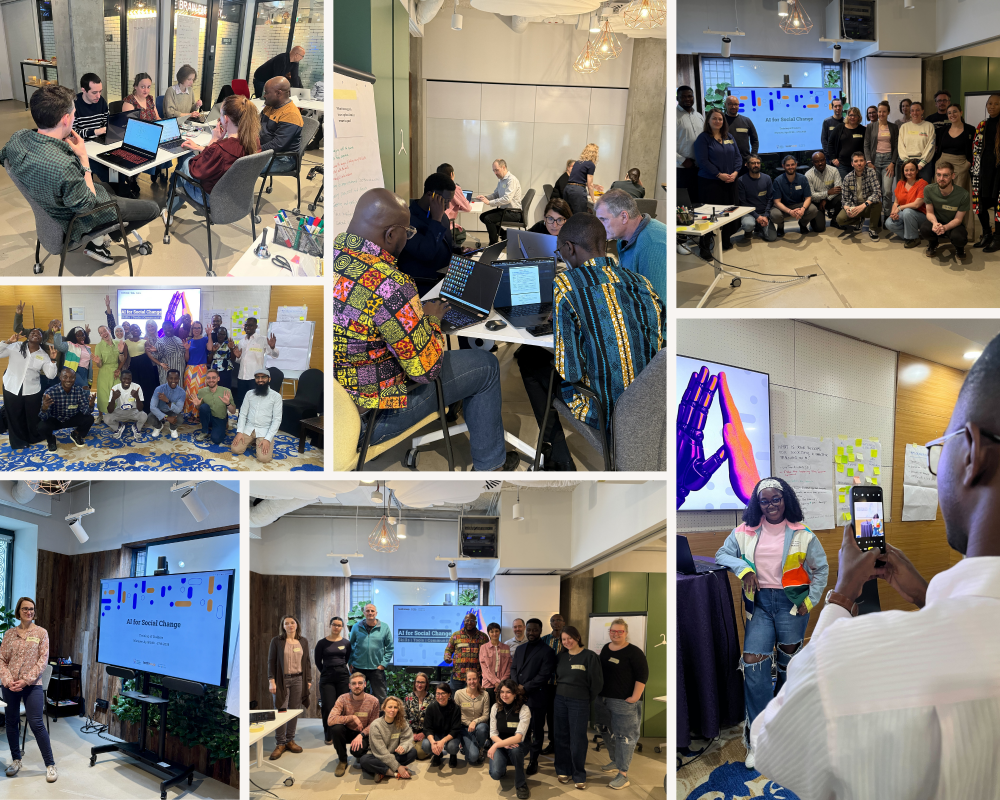
Between April and June 2026, three Training of Trainers cohorts brought together participants from across the region. The training program explored responsible AI policy creation and strategy, AI fundamentals, AI and effective communications, AI and information integrity, AI and digital safety, and practical ways to introduce AI inside nonprofits.
But what stood out wasn't a particular tool. It was the conversations.
Participants challenged one another, shared examples from their own organizations, compared approaches across countries, and openly discussed both the opportunities and the limitations of AI.
As one participant put it:
"We must focus on values and principles more than simply technical tools. AI is a practical tool for social change, not just a technical concept."
That perspective became one of the strongest threads running through the training program.
Why community matters
Training people to use AI is one thing. Helping them become trainers is something else entirely.
The training program wasn't designed to create AI experts; it was designed to build confidence.
Participants explored how to facilitate discussions, adapt training materials to local realities, and make AI approachable for organizations that may have limited resources or little previous experience.
As another participant observed:
"We need to emphasize local contexts and peer networks to solve upskilling challenges, while always focusing on human agency and the choices organizations can make."
This idea reflects something we often see across the Digital Activism Program: learning travels further when it moves through trusted communities. Knowledge doesn't stay in the room. It spreads through conversations, local workshops, and shared experiences.
There is no single way to teach AI
Perhaps the most reassuring message came from participants themselves:
"AI is a difficult subject, but with good tools we can make it easier. There are different ways to talk about it, and there is no need to be an expert to deliver AI training."
That shift in confidence may be one of the AI for Social Change Training of Trainers’ most important outcomes, because if more organizations feel comfortable starting conversations about AI, more communities will be able to explore how these technologies can support their missions responsibly and on their own terms.
Participants have also shared their reflections in a series of short video testimonials, offering a glimpse into their experiences and the ideas they'll take back to their organizations.
▶️ Watch the participant testimonials on the Hive Mind YouTube channel

Keeping the learning going
The learning didn't end when the workshops finished. Now, it is time for our cohort of 43 trainers to bring the learning to their local communities and organize their training sessions.
The Training of Trainers is only one part of AI for Social Change.
To help organizations continue exploring AI at their own pace in line with their very own needs, we launched the AI Resource Library on Hive Mind, bringing together practical guides, tutorials, articles, and other learning materials to be developed throughout the project.
Together with the Mapping and Needs Diagnosis Summary Report, these resources create an open collection that any civil society organization can use, whether they're just getting started or looking to deepen existing knowledge.

Looking ahead
The AI landscape will continue to change and evolve. The strength of civil society won't come from keeping up with every new tool. It will come from asking the right kind of questions, learning together, experimenting, and sharing what works in each context within a particular community. This is exactly what the AI for Social Change Training of Trainers set out to build: not a network of AI experts, but a community of practitioners who can help others function in this rapidly changing environment with confidence, curiosity, and care.
Disclaimers
This piece has been created as part of the AI for Social Change project within TechSoup's Digital Activism Program, with support from Google.org.
The content was created with AI assistance and has been reviewed and edited by Dominika Uzar, based on insights provided by Vyacheslav Melnyk and Maja Durlik.