Just as the calculator made complex mathematics accessible to everyone, AI is now making complex tasks easier by freeing up time for organizations to focus on what matters most: decision-making, impact, and the people they serve.
AI is here to stay. So, the question is no longer whether civil society organizations will use AI. The real question is whether they will use it responsibly.
Unlike private companies that optimize AI for efficiency or profit, civil society organizations operate within a moral contract: to protect dignity, reduce inequality, and do no harm. When AI tools are introduced into this space, they inherit that responsibility.
However, most AI tools used in Africa are designed elsewhere, trained on non-African data, and deployed without sufficient local scrutiny. Without ethical guardrails, these tools can unintentionally exclude the very people CSOs seek to serve.
For organizations that work with vulnerable communities, ethical failure is not a technical mistake; it is a human one. This makes AI ethics the first and most important safeguard before any deployment.
Therefore, responsible adoption must begin with clear ethical questions, not technical excitement.
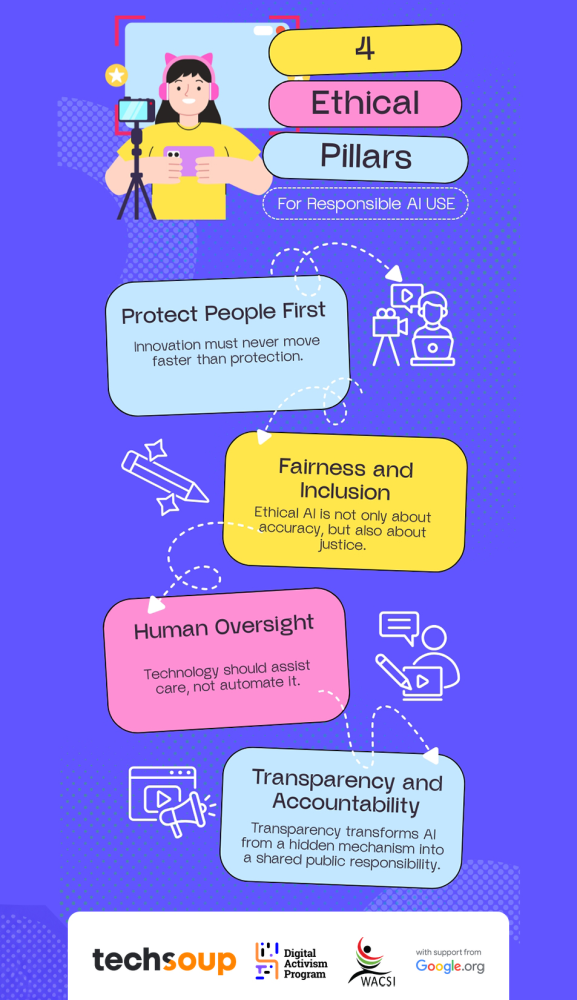
Four Ethical Pillars for Responsible AI Use
Responsible AI use in civil society organizations does not begin with technology, but with values. The following four pillars provide a practical ethical foundation for any CSO, both in West Africa and beyond that is seeking to adopt AI without compromising the people it exists to serve.
1. Do No Harm: Protect People First
Before adopting any AI tool, civil society organizations must ask a simple but critical question:
What happens if this tool malfunctions?
This is especially critical in contexts where AI tools are used to screen beneficiaries, assess needs, or distribute resources. A flawed algorithm in these settings does not simply produce a wrong answer. It can deny food, protection, or access to someone already in a crisis.
Misidentifying stakeholders, generating false information, or exposing sensitive data can create real-world harm. Ethical use requires risk awareness, human review of sensitive outputs, and clear limits on where automation is acceptable.
Innovation must never move faster than protection.
2. Fairness and Inclusion: Leave No One Behind
Bias in AI is widely documented, but in the CSO context, it becomes more dangerous. Tools trained on foreign datasets may fail to recognize local languages, informal economies, gender realities, or rural identities common across West Africa, as well as in other places.
A typical example is the widespread use of AI-generated images instead of real-life photographs on websites, advertisements, and posters. Images are forms of representation. When AI-generated images begin to replace real human images used for communication, it risks creating a culture where people no longer feel seen or represented.
That is why every decision to use AI should be assessed through the lens of cultural impact, especially whether it is quietly shifting the culture of representation.
CSOs must therefore examine:
Whether AI tools reflect African contexts
Who might be excluded or misrepresented
How inequality could be unintentionally reinforced
Ethical AI is not only about accuracy; it is also about justice. Understanding how bias shapes AI systems is a critical part of AI literacy. To learn more about this, you can read this article on recognizing bias in AI.
3. Oversight: Humans Must Lead Decision-making
AI can support decision-making, but it must not replace human judgment in areas affecting welfare, access to services, or protection outcomes. Civil society organizations should establish a simple internal test: if a human staff member made this same error, what would the consequence be? If the answer is serious, the decision must involve human hands.
Compassion, cultural understanding and contextual reasoning remain uniquely human responsibilities.
Every CSO using AI should ensure:
Humans review high-impact decisions
Staff are trained to question AI outputs
Automation is limited in sensitive interventions
Technology should assist care, not automate it.
4. Transparency and Accountability: Building the Trust
Trust is central to CSOs' legitimacy. Communities deserve to know when AI influences decisions that affect them, and disclosure builds that trust. If a community has already been disadvantaged by distant or foreign systems, how do you think they would react to another layer of AI-led abstraction determining the outcomes of causes that matter to them?
Responsible organizations should, as a priority, clearly communicate:
Where AI is being used
What data informs the tool
Who is accountable if harm occurs (a human, obviously — see Pillar 3)
Transparency transforms AI from a hidden mechanism into a shared public responsibility.
Your Feedback Matters
What did you think of this text? Take 30 seconds to share your feedback and help us create meaningful content for civil society!

Disclaimers
This piece of resource has been created as part of the AI for Social Change project within TechSoup's Digital Activism Program, with support from Google.org.
AI tools are evolving rapidly, and while we do our best to ensure the validity of the content we provide, sometimes some elements may no longer be up to date. If you notice that a piece of information is outdated, please let us know at content@techsoup.org.
This content was researched, developed, and written by Doreen Emmanuel Audu and edited with AI assistance.
About the Author
Doreen Emmanuel Audu is a Digital & AI Transformation and Government Affairs professional working at the intersection of technology, policy, and human-centered design. She specializes in responsible AI adoption, digital governance, and organizational capacity building — helping government institutions, civil society organizations, and their teams understand, adopt, and effectively use digital and AI tools in ways that are ethical, inclusive, and built around the people they serve.