This Ethical AI Checklist exists for one reason: to make sure the right questions are asked before any AI tool is adopted.
For CSOs, this is not a bureaucratic exercise, but an act of care. The communities you serve cannot have you get it wrong.
The gap between ethical intention and ethical practice is where harm happens. This checklist seeks to close that gap with a structured set of questions designed for any project lead, manager, or executive director to use before deploying a new AI tool, or when reviewing one already in use.
Use it before every new AI adoption. Return to it at agreed intervals for tools already embedded in your work. It is not a one-time gate, it is an ongoing commitment to responsible practice.
The Six Ethical Checkpoints
1. Purpose: Is this AI tool aligned with our organizational goals?
Before anything else, establish intent. AI should serve your mission, not complicate it. If you cannot articulate clearly how a specific tool supports a specific project outcome, then don’t bother implementing it.
2. Bias: Are outputs fair and accurate across all the communities we serve?
For example, most AI tools are trained on datasets that do not reflect West African contexts, in language, geography, gender expression, or economic reality.
Ask your vendor or developer: What data was this trained on? Has it been tested with communities like ours? If you cannot get a clear answer, run your own tests using local scenarios before full deployment.
3. Transparency: Can decisions be explained to stakeholders? Do beneficiaries know AI is involved?
Trust is your organization's most valuable asset. If an AI tool is influencing who receives support, who is flagged, or how resources are allocated, affected communities have a right to know. Internally, every staff member using an AI tool should be able to explain, in simple terms, what it does and what it cannot do. Disclose the use in plain language because hiding explanations in a mound of technical jargon is not a form of transparency.
4. Data: Is sensitive information adequately protected?
AI tools run on data. In civil society contexts, that data often includes names, locations, health status, displacement history, or financial details. Before connecting any dataset to an AI tool, confirm where data is stored, who has access, whether it crosses international borders and what your obligations are under applicable data protection law. If your organization works with, for example, children or survivors of violence, the threshold for data caution must be even higher.
5. Representation: Are the visuals and content produced by or through AI truly representative of the communities we serve?
This step is easy to overlook and costly to ignore. When AI-generated images replace real photographs in donor communications, project materials, or public campaigns, you can inadvertently center people outside our focus area. Before you know it, communities become invisible in narratives that are supposed to be about them. Before using AI-generated content publicly, ask: Does this reflect the actual people we work with? Would our communities recognize themselves here?
6. Oversight: Are humans actively monitoring AI-influenced decisions?
No AI tool should operate without a named person responsible for reviewing its output, especially in high-stakes areas such as stakeholder selection, case management, or safeguarding. Define escalation pathways, in other words, a hierarchy of reviewers and stakeholders responsible for decisions. Establish a review frequency and document who is accountable when something goes wrong. This way the organization is holding itself responsible for what technology produces.
Apply It
Take one AI tool your organization currently uses or is considering. Work through each of the six checkpoints and write down your answers. Where you cannot answer confidently, that is your action point.
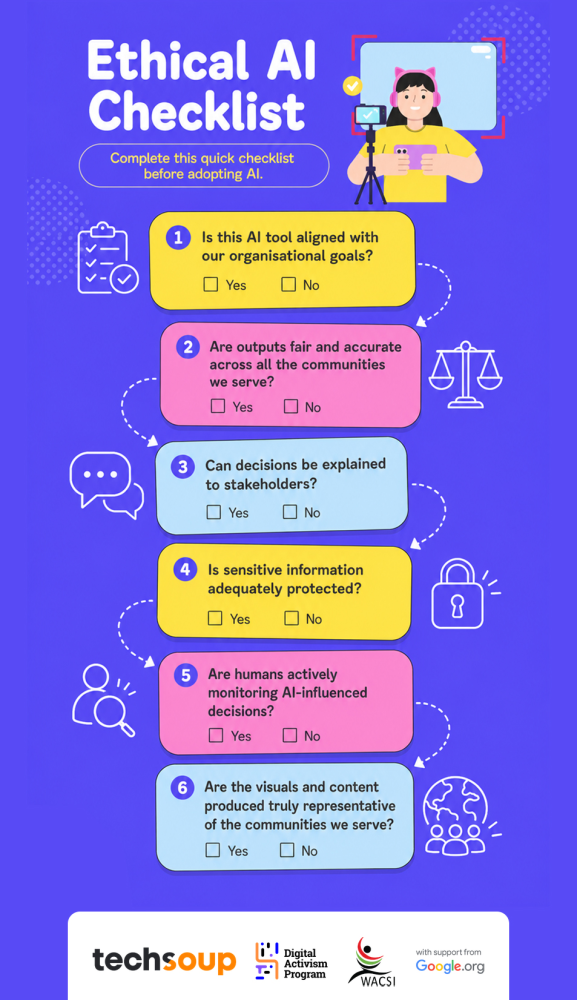 Ethical AI Checklist for Responsible AI Use within CSOs
Your Feedback Matters
What did you think of this text? Take 30 seconds to share your feedback and help us create meaningful content for civil society!

Disclaimers
This piece of resource has been created as part of the AI for Social Change project within TechSoup's Digital Activism Program, with support from Google.org.
AI tools are evolving rapidly, and while we do our best to ensure the validity of the content we provide, sometimes some elements may no longer be up to date. If you notice that a piece of information is outdated, please let us know at content@techsoup.org.
This content was researched, developed, and written by Doreen Emmanuel Audu and edited with AI assistance.
About the Author
Doreen Emmanuel Audu is a Digital & AI Transformation and Government affairs professional working at the intersection of technology, policy, and human-centred design. She specializes in responsible AI adoption, digital governance, and organizational capacity building — helping government institutions, civil society organizations, and their teams understand, adopt, and effectively use digital and AI tools in ways that are ethical, inclusive, and built around the people they serve.