Some of the participants arrived afraid, as several were worried that the level of AI skills would be far too high. Hours later, they held a document or a tool they could actually use. This article presents how the workshop helped the participants turn their AI knowledge into practical skills, leaving them more confident in using AI in their civil society organizations (CSOs), as well as shares practical workbooks from the training.
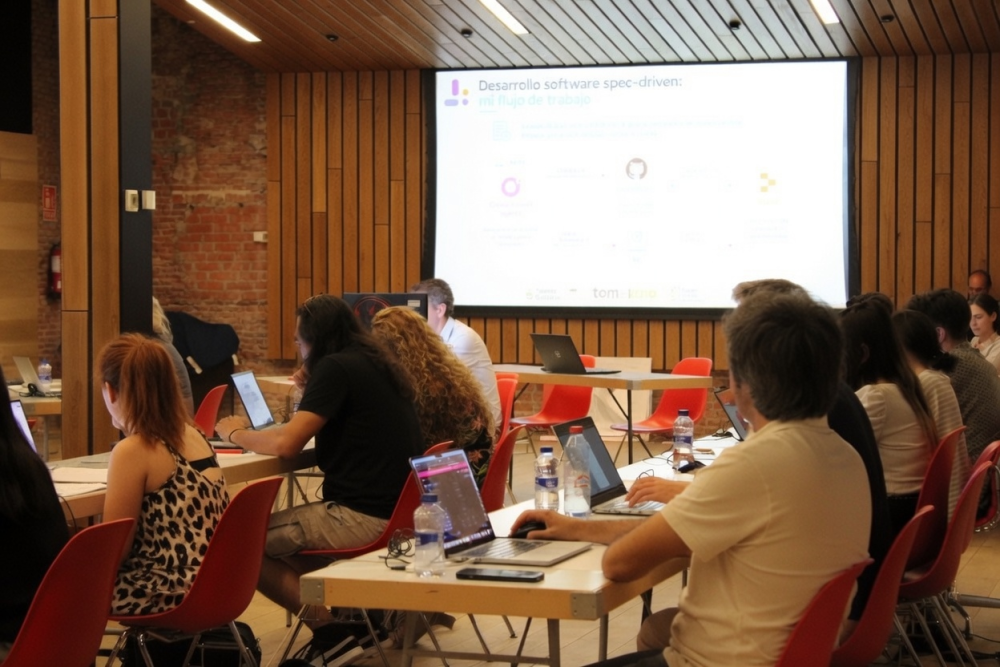
The Profile of the Participants
The 15 organizations belong to the Talento Solidario Network of the Fundación Botín. They work in disability and support employment, creating programs for social music, ALS, Alzheimer’s, hospitalized children, and international cooperation. Their day-to-day looks more alike than they imagine: chasing grants, writing project reports, reporting on funds, and managing tasks that often still live on paper. They are small teams, rarely with a technical profile.
They did not start from scratch. Before this session, they had completed seven webinars, fourteen hours, on the fundamentals of generative AI. They knew what ChatGPT or Gemini was. What they lacked was the leap: applying it to their own work and leaving with the job done.
A Method Built for Action
We designed the day as a hands-on workshop, not a lecture. Each use case came in a self-contained participant workbook: step by step, with every prompt ready to copy. The eight cases were not an imposed syllabus; they came from a prior survey of the organizations themselves, grouping what they asked for.
The most important decision was to let each organization choose its own case and work in parallel. Instead of the whole class moving at the same pace with the same example, each table followed its own path. That is why the workbooks had to stand on their own; we supported them, but we did not direct. Every so often, a 15-minute a “learning pill” changed the rhythm and covered a single topic: assistants, privacy, free tools, costs, apps, trends, or responsible AI.
They didn’t even stop during the breaks: the debates carried on even in the coffee queue. During one pause, the big question slipped in: who defines the ethics of AI? Participants emphasized the need for humanism to be involved in building and configuring the AI systems.
Before touching anything, we presented them with an opening block set of the data rules with a traffic light: green for what you can share, amber for what needs care, and red for what never goes into AI. Beneficiaries’ personal data is always red.
The workbooks build on TechSoup’s documentation from the AI for Social Change project (the C.R.A.F.T. method and metaprompting) and combine it with more advanced techniques: breaking a big task into steps, letting the AI ask you questions, flagging what an inference is, and reviewing the result.
What makes a text truly useful comes from the organization working on its real case and fine-tuning the prompts. That is why we hand over the workbooks as editable Word files, under a CC BY 4.0 license: to modify, improve, and share them.
The workbooks are available for your use as well!

Lessons Learned
The output is surprising for a single day. At Alzheimer Bierzo, they left with two tools built: “The whistleblowing channel is practically done, and so is the organization’s assistant.”
One of the organizations built an agent that gives basic information to every worker arriving at the foundation, drawing on its own documents. At Fundación Mozambique Sur, they fed the AI with the sources their team sent from the field: “It produced a very complete report, and it even flagged the points where information is still missing.”
Alzheimer Bierzo shared their AI assistant on their organization’s website on the spot. Two participants, from CESAL and Acción por la Música, showed apps they use for volunteer management and HR schedule management software. The effect continued beyond the workshop, as Asociación Achalay kept sharing the documents and prompts with the rest of the team over WhatsApp while working. A participant from the organization additionally commented on it, saying they "noticed a shift in the conversation and the interest of the board and the staff.”
Other organizations tackled real funding calls. ADELA reopened a La Caixa grant it had lost the year before and identified their mistakes. Alzheimer Bierzo used their new AI skills to tackle the FAMI call that had just come out that week.
What Stood Out The Most
If we had to keep one idea, it would be this: the key was not asking AI for things, but letting it ask questions to the participants. The FundHos organization noted on it as well saying that "having the AI ask me questions opened up a whole new world".
At Alzheimer Bierzo, they noticed that by slowing down and using the right prompts, you get much more. Accordingly, each participant adapted the workbook to their reality; at FundHos they tweaked it a little to fit their needs. The workbooks are a starting point, not a straitjacket.
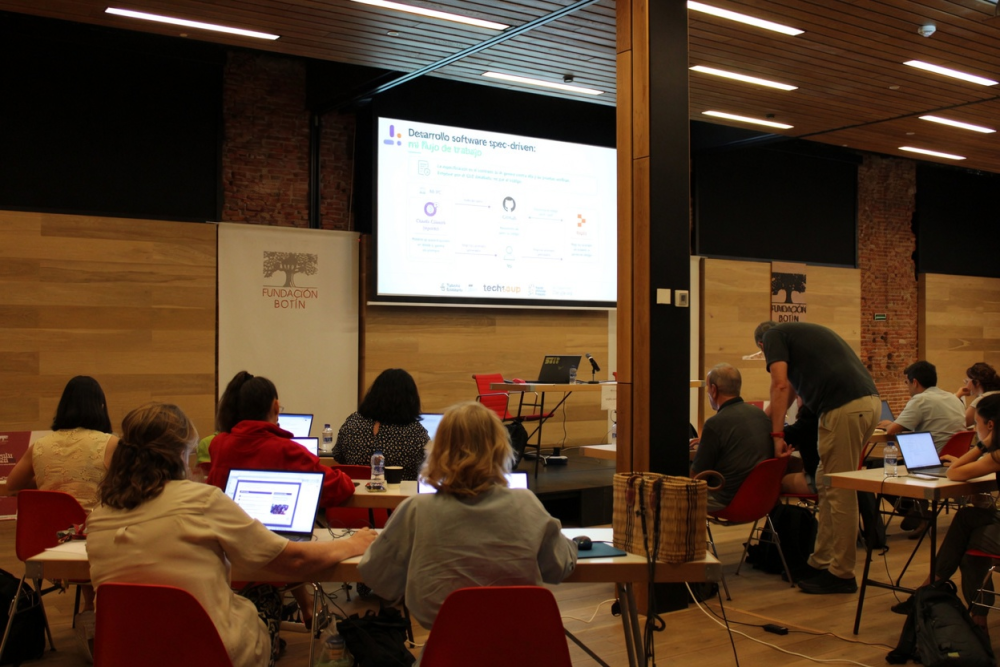
More Than a Tool: A Way of Thinking
For some participants, the biggest discovery of the day was not a document but a method. At CESAL, they admitted they’ve been reluctant to adopt AI, but left the workshop seeing it differently: “It has helped me as a working method: to be systematic and to organize how I approach things.”
For others, it worked as a mirror. At FundHos, they found that, by answering the AI’s questions, they saw their own processes clearly for the first time: where they get stuck, how long they take, what doesn’t work. The AI didn’t just help them write; it taught them to look at their own organization.
Limitations
Not everything went smoothly. The most common challenge was knowing when to stop. As one participant from KOMERA admitted, after spending hours on a raffle plugin: “it would have been easier to just sell the tickets.” At Juegaterapia, they commented on it jokingly: “I’m not sure we’re creating monsters today; you have to know when to stop.”
There was a real technical wall: building an app was possible; uploading it to a server was not. That required help, and not everyone got equally far. Having people with a technical profile who can build an app on the spot is wonderful, but it also widens the gap with those who are barely taking off, and it can become overwhelming. Someone admitted it honestly: at the “paste this into a code generator” step, their brain freezes. Two trainers for 15 organizations working in parallel fell short on paper; it worked because the workbooks were so detailed that they answered most questions on their own.
Fundación Senara raised the most uncomfortable question of the day: if AI gives everyone the same guidance, won’t applications end up looking too alike?
Use AI to do things better, not just faster. It is a superpower within everyone’s reach, but the real advantage lies in finding and telling each organization’s real difference.
The Outcomes From and Beyond the Workshop
Each organization left with one or two working solutions and a plan for the coming months. The common feedback was that the workshop “fell short, we’d need another session.” The challenge that remains is not technical; it is sustaining the habit at work, where something always interrupts you. The session’s motto frames it well: the goal is not to use AI once, but to build it into the way you work so you can do it again tomorrow.
Here is the most important part. Several people left determined to bring what they had learned into their organization and teach it to their colleagues. As one of the participants from the FUNDABEM organization put it: “We have to be generous and teach it to the rest of the network; there are only 15 of us, and we could be many more".
“We’re leaving eager to teach this to our colleagues,” they added at ADELA. This is AI for Social Change at its best: not 23 people trained, but 15 organizations becoming agents of change. That, and not any particular tool, is where social change with AI truly begins.
Your Feedback Matters
What did you think of this text? Take 30 seconds to share your feedback and help us create meaningful content for civil society!

A note of thanks
Thanks to my colleague Vicente de los Ríos, to the Fundación Botín for their support in the organization, and to TechSoup’s DAP Team and their wonderful gathering in Poland, which opened my mind to other ways of teaching AI and where I met extraordinary people.
Disclaimers
This piece of resource has been created as part of the AI for Social Change project within TechSoup's Digital Activism Program, with support from Google.org.
AI tools are evolving rapidly, and while we do our best to ensure the validity of the content we provide, sometimes some elements may no longer be up to date. If you notice that a piece of information is outdated, please let us know at content@techsoup.org.
The content was created, reviewed, and edited by Jon Merino with AI assistance.
About the Author
Jon Merino is an inventor, Telecommunication Engineer, musician, writer, speaker, and science communicator—if a single adjective can define him, it is "versatile" (or "restless spirit"). For the past 5 years, he has been working with Third Sector organizations, helping them with their digital transformation and the integration of AI into their processes. He designed and taught this workshop alongside his partner and associate Vicente de los Ríos as part of the Fundación Botín's Talento Solidario program.