Across Ghana’s civil society ecosystem, practitioners are grappling with real questions: Is AI just hype, or will it replace human jobs? Is entering internal organizational data safe, or does it invite security breaches? And how do we protect our communities from deepfakes, misinformation, and digital scams?
Behind both hesitation and blind optimism lies a common misconception: that AI is either a dangerous black box or an all-knowing engine that retrieves verified facts. Without strong competencies in AI literacy, digital safety, and information integrity, organizations risk falling into two costly traps: avoiding transformative tools out of fear, or trusting hallucinations and insecure platforms that compromise community data and organizational missions.
To address this, Happy Daffodils hosted the AI for Social Change workshop on August 22, 2026, at the Balme Library, University of Ghana. The session was delivered under TechSoup’s Digital Activism Program with support from Google.org.
Goal and Process: Amalgamating Three Curricula
Rather than treating tools, security, and verification as separate topics, we connected AI productivity directly with organizational resilience by merging three distinct curricula into a master curriculum:
1. Breaking Down Generative AI & Prompt Architecture: Establishing the human-AI partnership, LLM predictive mechanics and limitations, GIGO (Garbage In, Garbage Out), Gemini Notebook (formerly NotebookLM), the CRAFT framework, meta-prompting, reverse prompt engineering, and custom assistants (Google Gems, GPTs, and agents).
2. Digital Safety, Security & Governance for CSOs: Securing organizational accounts, preventing data leakage, drafting internal AI acceptable-use policies, and establishing incident response protocols.
3. Information Integrity & Verification: Spotting AI-generated synthetic media, countering deepfakes and scams, and fact-checking outputs before dissemination.
To set the stage before anyone began hands-on work on their laptops, we ran a two-round drawing exercise. In the first round, one participant gave generic, open-ended instructions while the rest of the class drew what they imagined. "Draw a house with a triangular roof. Put a front door in the middle, two square windows, and draw a tree right beside the house. Draw something in the sky." The resulting sketches were wildly different and humorous, clearly demonstrating that vague instructions lead to unpredictable outputs. Because the prompt left so much open to interpretation, participants drew everything from birds and airplanes to clouds and moons in the sky, while the trees ranged from mango and banana trees to generic leafy shrubs.
In the second round, the participant gave specific instructions and constraints:
“Draw a house with a square base and a triangular roof on top. At the bottom center of the house, draw a standing vertical rectangular front door. On the walls, draw two square windows at normal, equal window height: place one window on the wall to the left of the door, and one on the wall to the right. Draw a coconut palm tree standing outside, directly on the right side of the house. In the top-right corner of the sky, draw a circular sun with 4 straight rays pointing outward.”
With clear guardrails in place, nearly everyone produced an almost identical sketch. This created the core mental model for the day: AI does not fail because the tool is “incapable”; it fails because the human prompt lacks clear structure, context, and constraints.
 Image 1. A participant displays his sticky note sketch produced during the second round of the drawing exercise, showing how specific prompt instructions lead to precise outputs.
From there, we transitioned into the core frameworks:
Prompt Architecture & Source Grounding: Participants applied the CRAFT framework (Context, Role, Action, Format, Target) and meta-prompting to turn rough ideas into structured prompts. They built Custom Google Gems and GPTs to maintain organizational voice, applied reverse prompt engineering to replicate proven styles, and used Gemini Notebook (formerly NotebookLM) to ground outputs in their own documents without open-web hallucinations.
Organizational Safety & Governance: We introduced the 4 Circles of AI & Cybersecurity framework (Individual Security, Internal Organizational Security, External Data Management, and Defense Against External Attacks), classified data into three clear tiers (PII, Confidential, and Public) to prevent leaks, and guided organizations on leveraging Google for Nonprofits for enterprise-grade workspace security.
Information Integrity & Verification: Participants learned the 4-Step Verification Habit (WHO, WHAT, WHEN, WHERE ELSE) alongside tools like Google Lens and InVID, reinforcing a proactive defense routine: PAUSE, CHECK, VERIFY, and PROTECT against synthetic media, deepfakes, and fraud.
Target Group & Cohort Profile
We initially confirmed 27 representatives across Ghana, spanning diverse civil society organizations such as Grow Ghana, BWS Robotics and AI Lab, Esteem Resources Africa, Loveaid Foundation, Caritas Ghana, and Upcycle It Ghana, among others.
On the morning of the training, early rain caused commute delays across Accra. Despite this, 15 participants arrived at the venue, allowing us to deliver an intimate, highly interactive workshop.
The Facilitator’s "Aha!" Moment
My personal highlight occurred during the opening session. Before attending the Training of Trainers (ToT) in Nairobi, I spent time researching and taking AI coursework to really understand both the back end and front end. Like many others, I initially assumed that generative AI retrieved verified facts. Discovering that large language models do not retrieve facts, but are actually engines predicting the next word based on statistical patterns, was my own initial “aha!” moment, and it transformed how I approached AI.
Being able to pass that insight on to the group was fulfilling. Just like I had months before, most participants entered the room believing that generative AI operates like an all-knowing search engine. When I explained the mechanics, I saw the immediate shock and curiosity across the room.
This computational reality explained why AI can be "confidently wrong" by delivering hallucinations with fluency. Because good grammar does not guarantee facts, verifying AI outputs became non-negotiable.
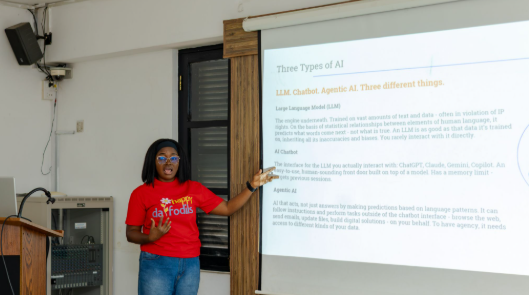 Image 2. Trainer Celestine Agropah explains the mechanics behind generative AI to participants.
The Participants' "Aha!" Moment
For the participants, the real "aha!" moments came during the practical sprints where they applied the CRAFT framework and practiced meta-prompting to turn rough ideas into precise instructions. Working through real non-profit scenarios, they saw how adding clear constraints transformed generic requests into well-structured community campaigns, grant outlines, and stakeholder communications.
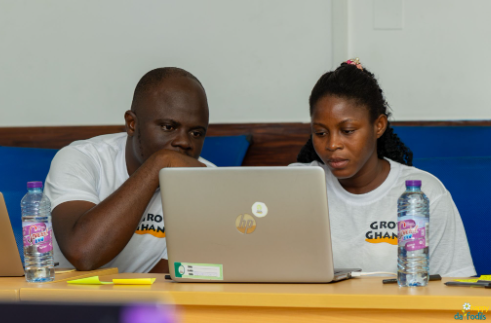
Image 3. Participants collaborate in pairs during the prompt engineering exercises.
Reflecting on the practical value of the session during post-workshop interviews, Sandra Esinam Sosu-Dees, Team Lead at Dunu.Srornu, shared her experience:
"The 'aha!' moment that I had was learning how to use CRAFT to do my promptings. I’ve been using AI for a while, but that framework has never come to me before… I had to learn that here. When I used it as an example in trying to draft a proposal, the results it gave me made me realize that I have not been utilizing AI as much as I should. I really enjoyed CRAFT. Kudos to the trainer, she did a very good job. When I get back home, I am going to firm all of it up for my organization. The best part about it was that it was completely free, and the food was great and unexpected!"
Another critical discussion centered on data handling. Several participants acknowledged that they had previously pasted beneficiary details and internal program notes into free, public AI tools without realizing that this data could be used to train models. Walking through the three data classification tiers provided clear boundaries on what is safe to process, what must be sanitized, and what must remain offline.
As participants worked through these scenarios and data principles, their reflections highlighted immediate shifts in mindset: “AI is an assistant to help us complete our tasks,” noted one participant, while another emphasized, “I should not be sharing personal or sensitive data with AI.” A third added, “We must always verify any output.”
Learning how to leverage Google for Nonprofits, configure organizational accounts, and establish basic AI policies gave the cohort confidence to adopt AI responsibly without compromising community privacy.
The Closing Circle: One Word, One Commitment
To close the workshop, participants gathered for a final circle reflection. Each person shared two things: how they view AI, paired with one commitment they were taking back to their organization:
Perspective: Tool → Commitment: Prudence (viewing AI strictly as an instrument that demands human oversight and verification)
Perspective: Companion → Commitment: Security (welcoming AI as an everyday assistant, while maintaining strict boundaries around data privacy)
Perspective: Partner → Commitment: Integrity (collaborating closely with AI while ensuring all work remains ethical and transparent)
Perspective: Addend → Commitment: Internal Team Training (viewing AI as an addition to existing skills, pledged to pass on the knowledge to train colleagues)
ToT Connection: Localizing the Global Framework
This workshop was part of the global AI for Social Change initiative. Drawing from the Train-the-Trainer (ToT) sessions in Nairobi, I combined key components from three curricula into a single curriculum tailored to Ghanaian CSOs working across grassroots community development, youth empowerment, rural education, digital inclusion, and environmental sustainability.
We integrated practical frameworks, the right tools, data privacy, and information integrity directly into everyday operations and community workflows. This ensured participants left not just with technical skills, but with the confidence to introduce safe, responsible, and smart AI practices to their teams and the communities they serve.
The “So What?”
Participants departed feeling that every minute spent in the room offered value for their daily work. The demand for follow-up was immediate: several requested repeat sessions or multi-day masterclasses with deeper hands-on practicals, and one organization requested an on-site training session for their entire team.
High Overall Satisfaction: 92.9% of participants rated the training as exceptional.
Direct Professional Utility: 100% of respondents agreed that the workshop content is directly applicable to their work, with 85.7% strongly agreeing.
Knowledge and Skills Growth: 100% of participants confirmed that the training increased their AI knowledge (78.6% strongly agreeing) and improved their capability to deploy AI tools responsibly (64.3% strongly agreeing).
Responsible AI & Verification in Practice: In open responses, participants highlighted data security, the CRAFT framework, and output verification as their top operational shifts.
Community Demand: Participants advocated for ongoing digital literacy and AI awareness initiatives: "Awareness is important, so more of these, especially in our schools would be good."
Post-Training Support & Future Direction
The engagement has continued well beyond the training day. Beyond sharing session materials, we have provided participants with ongoing guidance on drafting internal AI and data privacy policies, along with step-by-step onboarding support for Google for Nonprofits. Moving forward, future iterations will expand to include more technical modules to match the growing technical appetite of our civic tech and digital advocacy partners.
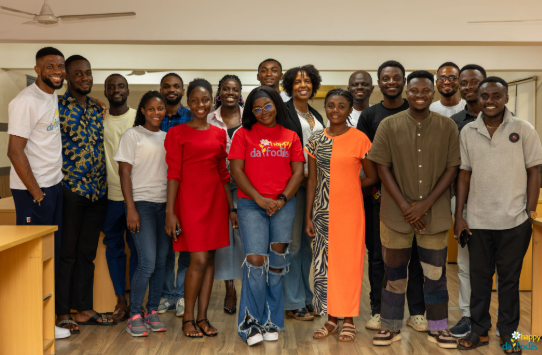
Figure 4. Participants gather with facilitator Celestine Agropah at the close of the workshop.
Curriculum & Resources
To support civil society practitioners on their journey, we have made our slide deck available for download below under a Creative Commons Attribution (CC BY 4.0) license.
💡 For those wanting deeper technical practice, pairing these slides with self-paced platforms like DataCamp offers the practical skills needed to build data- and AI-ready organizations.
🎟️ For License Access: Civil society practitioners or grassroots organizations seeking sponsored access to DataCamp tracks can contact the Happy Daffodils team at info@happydaffodils.org to inquire about available scholarship licenses.
Your Feedback Matters
What did you think of this text? Take 30 seconds to share your feedback and help us create meaningful content for civil society!

Disclaimers
This piece of resource has been created as part of the AI for Social Change project within TechSoup's Digital Activism Program, with support from Google.org.
AI tools are evolving rapidly, and while we do our best to ensure the validity of the content we provide, sometimes some elements may no longer be up to date. If you notice that a piece of information is outdated, please let us know at content@techsoup.org.
The content was created, reviewed, and edited by Celestine Agropah with AI assistance.
About the Author
Celestine Agropah is a Data & Analytics Engineer, Tech Educator, and the Founder & Executive Director of Happy Daffodils, a non-profit organization advancing digital inclusion, education, and technology access for children in rural and underserved communities in Ghana.